

June Reading from The Message
How long would you wait for your leader to return—three days? Seven? Could you wait a full forty days? For the people of Israel, it was too long. Anxiety crept in and turned to what was familiar. As told in Exodus 32, they crafted a god in their own image. Can we relate? We, too, are often impatient—longing for a god who serves us, instead of waiting on the God we are called to serve.
When the people realized that Moses was taking forever in coming down off the mountain, they rallied around Aaron and said, “Do something. Make gods for us who will lead us. That Moses, the man who got us out of Egypt—who knows what’s happened to him?”
So Aaron told them, “Take off the gold rings from the ears of your wives and sons and daughters and bring them to me.” They all did it; they removed the gold rings from their ears and brought them to Aaron. He took the gold from their hands and cast it in the form of a calf, shaping it with an engraving tool.
The people responded with enthusiasm: “These are your gods, O Israel, who brought you up from Egypt!”
Aaron, taking in the situation, built an altar before the calf. Aaron then announced, “Tomorrow is a feast day to God!”
Early the next morning, the people got up and offered Whole-Burnt-Offerings and brought Peace-Offerings. The people sat down to eat and drink and then began to party. It turned into a wild party!
God spoke to Moses, “Go! Get down there! Your people whom you brought up from the land of Egypt have fallen to pieces. In no time at all they’ve turned away from the way I commanded them: They made a molten calf and worshiped it. They’ve sacrificed to it and said, ‘These are the gods, O Israel, that brought you up from the land of Egypt!’”
God said to Moses, “I look at this people—oh! what a stubborn, hard-headed people! Let me alone now, give my anger free reign to burst into flames and incinerate them. But I’ll make a great nation out of you.”
Moses tried to calm his God down. He said, “Why, God, would you lose your temper with your people? Why, you brought them out of Egypt in a tremendous demonstration of power and strength. Why let the Egyptians say, ‘He had it in for them—he brought them out so he could kill them in the mountains, wipe them right off the face of the Earth.’ Stop your anger. Think twice about bringing evil against your people! Think of Abraham, Isaac, and Israel, your servants to whom you gave your word, telling them ‘I will give you many children, as many as the stars in the sky, and I’ll give this land to your children as their land forever.’”
And God did think twice. He decided not to do the evil he had threatened against his people.
Moses turned around and came down from the mountain, carrying the two tablets of The Testimony. The tablets were written on both sides, front and back. God made the tablets and God wrote the tablets—engraved them.
When Joshua heard the sound of the people shouting noisily, he said to Moses, “That’s the sound of war in the camp!”
But Moses said, Those aren’t songs of victory, And those aren’t songs of defeat, I hear songs of people throwing a party.
And that’s what it was. When Moses came near to the camp and saw the calf and the people dancing, his anger flared. He threw down the tablets and smashed them to pieces at the foot of the mountain. He took the calf that they had made, melted it down with fire, pulverized it to powder, then scattered it on the water and made the Israelites drink it.
Moses said to Aaron, “What on Earth did these people ever do to you that you involved them in this huge sin?”
Aaron said, “Master, don’t be angry. You know this people and how set on evil they are. They said to me, ‘Make us gods who will lead us. This Moses, the man who brought us out of Egypt, we don’t know what’s happened to him.’
“So I said, ‘Who has gold?’ And they took off their jewelry and gave it to me. I threw it in the fire and out came this calf.”
Moses saw that the people were simply running wild—Aaron had let them run wild, disgracing themselves before their enemies. He took up a position at the entrance to the camp and said, “Whoever is on God’s side, join me!” All the Levites stepped up.
He then told them, “God’s orders, the God of Israel: ‘Strap on your swords and go to work. Crisscross the camp from one end to the other: Kill brother, friend, neighbor.’”
The Levites carried out Moses’ orders. Three thousand of the people were killed that day.
Moses said, “You confirmed your ordination today—and at great cost, even killing your sons and brothers! And God has blessed you.”
The next day Moses addressed the people: “You have sinned an enormous sin! But I am going to go up to God; maybe I’ll be able to clear you of your sin.”
Moses went back to God and said, “This is terrible. This people has sinned—it’s an enormous sin! They made gods of gold for themselves. And now, if you will only forgive their sin. . . . But if not, erase me out of the book you’ve written.”
God said to Moses, “I’ll only erase from my book those who sin against me. For right now, you go and lead the people to where I told you. Look, my Angel is going ahead of you. On the day, though, when I settle accounts, their sins will certainly be part of the settlement.”
God sent a plague on the people because of the calf they and Aaron had made.
Scripture Insight
Wait for God to Speak
Moses had been gone a long time, forty days and nights. Meanwhile, the people, impatient to get on with their new life of freedom, decided that they wanted to develop their own worship—worship that, in the phrase of our times, they could “get something out of.” So they talked their associate pastor, Aaron, into providing them with worship that satisfied their desire—something that turned out to be pretty much a reflection of the gaudy Egyptian world in which they had so recently been oppressed, but a world that they had also envied, as oppressed people often do as excluded outsiders.
We know what happened with the Israelites. Their golden-calf worship—which was self-defined, impatient, unreflective, and self-serving—nearly destroyed them. And the same sin has nearly destroyed us. Refusing to wait for God to speak, we fill in his silence with activity. We raise money for things. We build things. We look at the way things were done in Egypt, and we model our worship after patterns that are familiar to us and seem to work for others, patterns that leave out ambiguity and mystery as well as waiting on God and listening for him. And all with tragic consequences, not least in the spiritual realm.
FREE copy of the Psalms for Students
God wants to meet students in these pages! It’s time for a new generation to read God’s Word in a conversational and down-to-earth cadence. Click the image below to get a free copy of The Message Student Devotional Bible: Psalms.
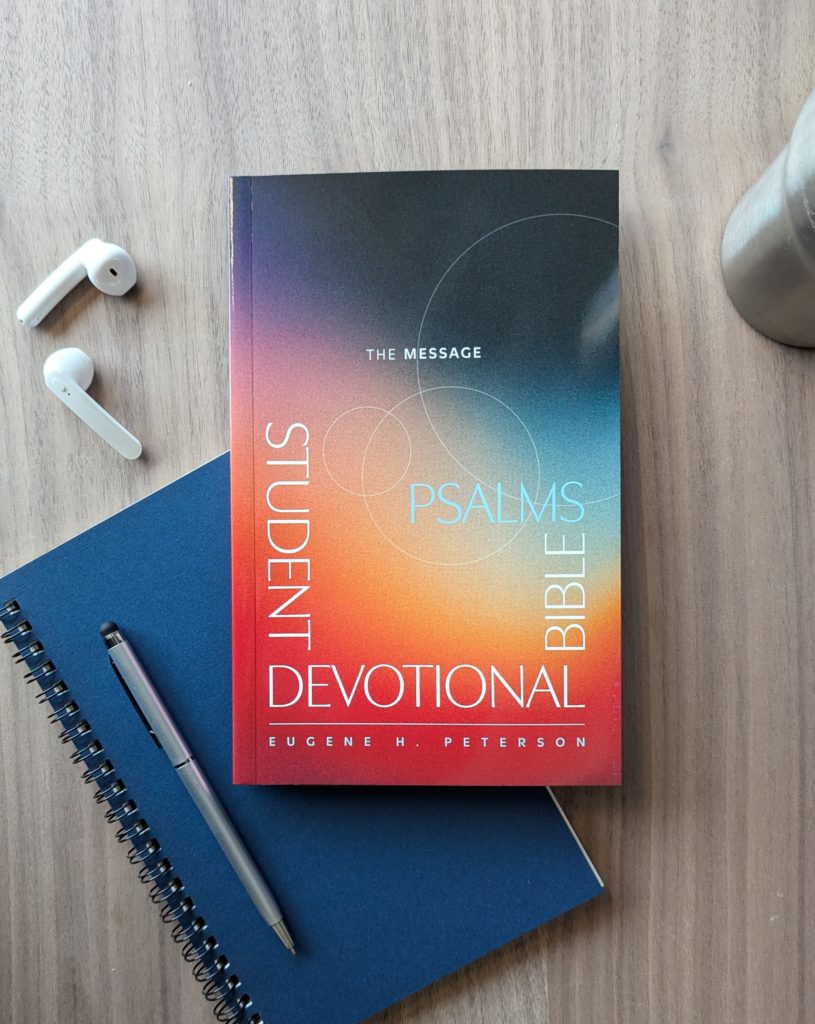
New supplemental features make this a highly useable and engaging resource for contemporary students as they seek to discover the way of Jesus in the pages of the Bible. A carefully selected network of youth ministry professionals provide devotional content for this portion and the full Bible. Key features of this edition include:
- Genre and book intros tailored to students
- 26 devotions with guided reflection
- Guidance from youth ministry leaders on why the Bible matters and how to read it effectively
- Highly readable format